We use cookies to understand how you use our site and to improve your experience.
This includes personalizing content and advertising.
By pressing "Accept All" or closing out of this banner, you consent to the use of all cookies and similar technologies and the sharing of information they collect with third parties.
You can reject marketing cookies by pressing "Deny Optional," but we still use essential, performance, and functional cookies.
In addition, whether you "Accept All," Deny Optional," click the X or otherwise continue to use the site, you accept our Privacy Policy and Terms of Service, revised from time to time.
You are being directed to ZacksTrade, a division of LBMZ Securities and licensed broker-dealer. ZacksTrade and Zacks.com are separate companies. The web link between the two companies is not a solicitation or offer to invest in a particular security or type of security. ZacksTrade does not endorse or adopt any particular investment strategy, any analyst opinion/rating/report or any approach to evaluating individual securities.
If you wish to go to ZacksTrade, click OK. If you do not, click Cancel.
Why These 4 Retail REITs Merit Attention Even After Fed's Rate Hike
Read MoreHide Full Article
Key Takeaways
Regency Centers has a $41M signed-not-occupied rent pipeline and about $1.5B of revolver availability.
Phillips Edison posted 97.3% occupancy, 21.2% renewal spreads and 33.7% new lease spreads.
Tanger had 96.6% occupancy, a 10.5% blended cash rent spread and about $1B of immediate liquidity.
The Federal Reserve’s latest rate hike by 25 basis points to 3.75%-4.00% has brought interest-rate risk back into focus for real estate investors. Higher borrowing costs can make refinancing more expensive, put pressure on property values and increase competition from fixed-income investments. For REITs, this means balance sheet strength, tenant demand and the ability to grow rents become even more important.
Retail REITs, however, enter this environment with several structural supports. Regency Centers (REG - Free Report) , Phillips Edison & Company (PECO - Free Report) , Tanger (SKT - Free Report) and Curbline Properties (CURB - Free Report) operate across retail formats that benefit from recurring consumer traffic, strong tenant demand and limited availability of well-located space.
The broader retail property market remains relatively healthy. Cushman & Wakefield points to tight availability across many shopping center markets, while new construction remains restrained. Limited development is important because it reduces the risk of excess supply and can strengthen landlords’ position when negotiating new leases or renewals.
Demand is also being supported by retailers focused on grocery, value, health, wellness, restaurants and other service-oriented categories. Many of these businesses depend on physical locations to reach customers, which helps maintain demand for neighborhood centers, open-air properties and convenience-focused retail assets.
The rate backdrop still creates risks, particularly for highly leveraged property owners or those facing large refinancing needs. Yet retail REITs with quality locations, healthy occupancy, embedded rent growth and financial flexibility can continue to expand cash flows even when interest rates stay elevated. This makes select retail landlords worth watching despite the Fed’s tighter stance.
4 Retail REIT Stocks to Keep on the Radar
Regency Centers: Regency Centers owns, operates and develops shopping centers in suburban trade areas, with a portfolio that totaled 482 centers and nearly 59 million square feet as of June 30, 2026. More than 85% of its portfolio consists of grocery-anchored neighborhood and community centers, while necessity, service, convenience and value-oriented retailers form a large part of the tenant mix.
This positioning gives Regency several paths to grow without depending on a major improvement in the rate environment. Its net debt plus preferred stock to trailing 12-month EBITDAre was 5.0X, while revolver availability was about $1.5 billion. Regency also had roughly $680 million of development and redevelopment projects in process at an estimated stabilized yield near 9% as of second-quarter 2026. A $41 million signed-not-occupied rent pipeline adds another source of embedded growth as leases commence.
Phillips Edison & Company: Phillips Edison is built around grocery-anchored neighborhood shopping centers, a format tied closely to recurring household spending. As of June 30, 2026, PECO had 330 centers spanning 37.4 million square feet. Grocery-anchored centers generated 94% of annualized base rent, while necessity-based neighbors accounted for 74%, giving the portfolio an everyday-retail tilt.
The leasing profile strengthens that case. Portfolio occupancy stood at 97.3%, while comparable renewal and new lease spreads were 21.2% and 33.7%, respectively. PECO also reported an 89.6% retention rate, helping reduce downtime and leasing capital. Its Everyday Retail strategy provides another growth channel: about $237 million has been invested in 12 centers since 2023. Balance sheet risk is also moderated by 96% fixed-rate debt and an $857 million liquidity position.
PECO currently carries a Zacks Rank #2. The consensus mark for 2026 and 2027 FFO per share calls for a 6.54% and 5.30% increase year over year, respectively.
Tanger: Tanger owns and operates outlet and other open-air retail destinations designed around brand-name shopping, dining and entertainment. Its portfolio includes 38 outlet centers and four open-air lifestyle centers, totaling nearly 17 million square feet across 22 U.S. states and Canada. More than 3,000 stores operated by more than 800 brands provide a broad tenant base and help diversify exposure across retail categories.
The investment case rests on productive centers, leasing demand and financial flexibility. Occupancy was 96.6% as of June 30, 2026, while average tenant sales reached $487 per square foot for the trailing 12 months. Comparable leasing generated a 10.5% blended cash rent spread. Tanger also carried net debt to adjusted EBITDAre of 4.7X and about $1 billion of immediate liquidity, giving it room to fund remerchandising, acquisitions and other portfolio investments, while rates remain elevated.
Tanger currently has a Zacks Rank #2. The Zacks Consensus Estimate for its 2026 and 2027 FFO per share indicates a 6.87% and 4.78% year-over-year increase, respectively.
Curbline Properties: Curbline Properties offers a different retail model. The company describes itself as the first REIT focused exclusively on convenience properties, typically located along well-trafficked intersections and vehicle corridors. Its roughly 6 million-square-foot portfolio emphasizes access, visibility, dedicated parking and standardized unit sizes, features that can appeal to national service, food, telecom and other convenience-oriented tenants.
The model is showing strong leasing economics while requiring relatively modest property capital. Curbline’s leased rate was 96.5% as of June 30, 2026, while second-quarter straight-line spreads reached 27.1% on new leases and 18.1% on renewals. Capital expenditures were 8.8% of NOI. The company has also completed more than $1.5 billion of acquisitions since its October 2024 spin-off and had $851 million of cash and capital commitments available for future acquisitions at quarter-end.
CURB currently carries a Zacks Rank #2. The consensus mark for 2026 and 2027 FFO per share suggests a 16.98% and 13.23% increase year over year, respectively.
Note: Anything related to earnings presented in this write-up represents funds from operations (FFO), a widely used metric to gauge the performance of REITs.



 View the Zacks #1 Rank List

Image: Bigstock
Why These 4 Retail REITs Merit Attention Even After Fed's Rate Hike
Key Takeaways
The Federal Reserve’s latest rate hike by 25 basis points to 3.75%-4.00% has brought interest-rate risk back into focus for real estate investors. Higher borrowing costs can make refinancing more expensive, put pressure on property values and increase competition from fixed-income investments. For REITs, this means balance sheet strength, tenant demand and the ability to grow rents become even more important.
Retail REITs, however, enter this environment with several structural supports. Regency Centers (REG - Free Report) , Phillips Edison & Company (PECO - Free Report) , Tanger (SKT - Free Report) and Curbline Properties (CURB - Free Report) operate across retail formats that benefit from recurring consumer traffic, strong tenant demand and limited availability of well-located space.
The broader retail property market remains relatively healthy. Cushman & Wakefield points to tight availability across many shopping center markets, while new construction remains restrained. Limited development is important because it reduces the risk of excess supply and can strengthen landlords’ position when negotiating new leases or renewals.
Demand is also being supported by retailers focused on grocery, value, health, wellness, restaurants and other service-oriented categories. Many of these businesses depend on physical locations to reach customers, which helps maintain demand for neighborhood centers, open-air properties and convenience-focused retail assets.
The rate backdrop still creates risks, particularly for highly leveraged property owners or those facing large refinancing needs. Yet retail REITs with quality locations, healthy occupancy, embedded rent growth and financial flexibility can continue to expand cash flows even when interest rates stay elevated. This makes select retail landlords worth watching despite the Fed’s tighter stance.
4 Retail REIT Stocks to Keep on the Radar
Regency Centers: Regency Centers owns, operates and develops shopping centers in suburban trade areas, with a portfolio that totaled 482 centers and nearly 59 million square feet as of June 30, 2026. More than 85% of its portfolio consists of grocery-anchored neighborhood and community centers, while necessity, service, convenience and value-oriented retailers form a large part of the tenant mix.
This positioning gives Regency several paths to grow without depending on a major improvement in the rate environment. Its net debt plus preferred stock to trailing 12-month EBITDAre was 5.0X, while revolver availability was about $1.5 billion. Regency also had roughly $680 million of development and redevelopment projects in process at an estimated stabilized yield near 9% as of second-quarter 2026. A $41 million signed-not-occupied rent pipeline adds another source of embedded growth as leases commence.
REG currently carries a Zacks Rank #2 (Buy). The Zacks Consensus Estimate for its 2026 and 2027 FFO per share suggests increases of 4.74% and 4.64% year over year, respectively. You can see the complete list of today’s Zacks #1 Rank (Strong Buy) stocks here.
YTD Price Performance of Retail REITs
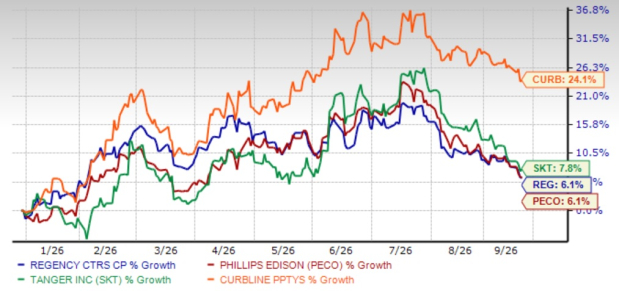
Image Source: Zacks Investment Research
Phillips Edison & Company: Phillips Edison is built around grocery-anchored neighborhood shopping centers, a format tied closely to recurring household spending. As of June 30, 2026, PECO had 330 centers spanning 37.4 million square feet. Grocery-anchored centers generated 94% of annualized base rent, while necessity-based neighbors accounted for 74%, giving the portfolio an everyday-retail tilt.
The leasing profile strengthens that case. Portfolio occupancy stood at 97.3%, while comparable renewal and new lease spreads were 21.2% and 33.7%, respectively. PECO also reported an 89.6% retention rate, helping reduce downtime and leasing capital. Its Everyday Retail strategy provides another growth channel: about $237 million has been invested in 12 centers since 2023. Balance sheet risk is also moderated by 96% fixed-rate debt and an $857 million liquidity position.
PECO currently carries a Zacks Rank #2. The consensus mark for 2026 and 2027 FFO per share calls for a 6.54% and 5.30% increase year over year, respectively.
Tanger: Tanger owns and operates outlet and other open-air retail destinations designed around brand-name shopping, dining and entertainment. Its portfolio includes 38 outlet centers and four open-air lifestyle centers, totaling nearly 17 million square feet across 22 U.S. states and Canada. More than 3,000 stores operated by more than 800 brands provide a broad tenant base and help diversify exposure across retail categories.
The investment case rests on productive centers, leasing demand and financial flexibility. Occupancy was 96.6% as of June 30, 2026, while average tenant sales reached $487 per square foot for the trailing 12 months. Comparable leasing generated a 10.5% blended cash rent spread. Tanger also carried net debt to adjusted EBITDAre of 4.7X and about $1 billion of immediate liquidity, giving it room to fund remerchandising, acquisitions and other portfolio investments, while rates remain elevated.
Tanger currently has a Zacks Rank #2. The Zacks Consensus Estimate for its 2026 and 2027 FFO per share indicates a 6.87% and 4.78% year-over-year increase, respectively.
Curbline Properties: Curbline Properties offers a different retail model. The company describes itself as the first REIT focused exclusively on convenience properties, typically located along well-trafficked intersections and vehicle corridors. Its roughly 6 million-square-foot portfolio emphasizes access, visibility, dedicated parking and standardized unit sizes, features that can appeal to national service, food, telecom and other convenience-oriented tenants.
The model is showing strong leasing economics while requiring relatively modest property capital. Curbline’s leased rate was 96.5% as of June 30, 2026, while second-quarter straight-line spreads reached 27.1% on new leases and 18.1% on renewals. Capital expenditures were 8.8% of NOI. The company has also completed more than $1.5 billion of acquisitions since its October 2024 spin-off and had $851 million of cash and capital commitments available for future acquisitions at quarter-end.
CURB currently carries a Zacks Rank #2. The consensus mark for 2026 and 2027 FFO per share suggests a 16.98% and 13.23% increase year over year, respectively.
Note: Anything related to earnings presented in this write-up represents funds from operations (FFO), a widely used metric to gauge the performance of REITs.